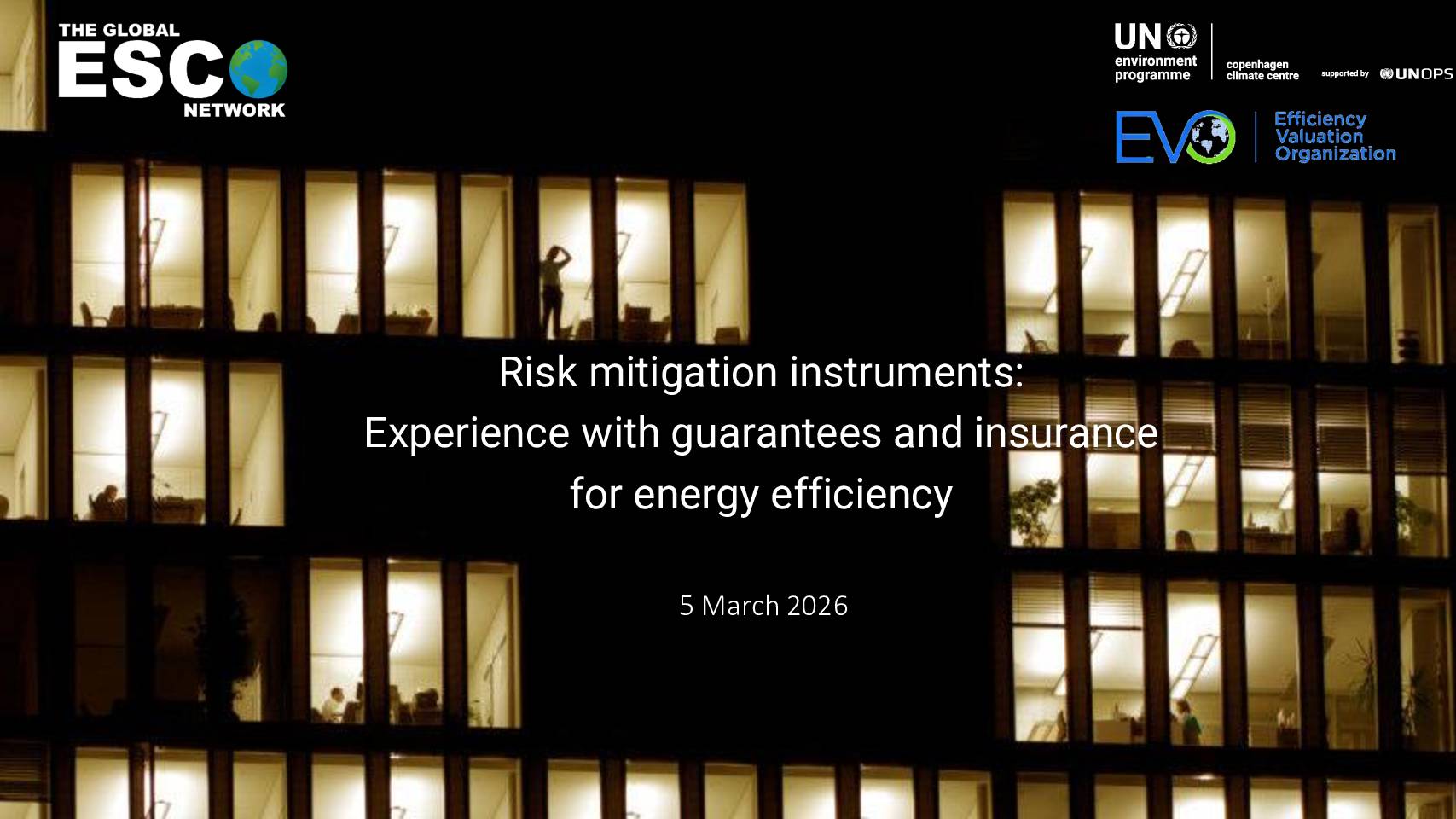
The 34th Global ESCO Network webinar, hosted by Søren Lütken, explored how guarantees and risk‑mitigation instruments can accelerate clean energy and energy efficiency investments. Opening the session, Søren highlighted the importance of financial de‑risking, noting that “guarantees are the most prominent instrument for promoting climate investments”.
The first speaker, Cornelia Schenk of the OECD, presented new analysis from the Clean Energy Finance and Investment Mobilisation Programme, explaining that global progress requires rapidly scaling private investment in emerging markets. She emphasised that despite their potential, “guarantees remain underutilised,” with use declining after 2019 due to complexity, regulatory hurdles, and limited project pipelines. Drawing on case studies from India and Saint Lucia, she underscored that “partial credit guarantees in local currency can unlock domestic financing” and that political risk insurance remains crucial where regulatory uncertainty is high.
Next, Sanjay Dube, CEO of the International Institute for Energy Conservation, outlined persistent barriers to energy‑efficiency finance—including small project size, high perceived risks, and limited trust between technical and financial stakeholders. He argued that new hybrid instruments are emerging, stressing that “there is a high need for energy efficiency and finance experts to come together to unlock financing”. Sanjay highlighted the growing role of energy savings insurance (ESI) and newer commercial insurance products that “could become strong de‑risking instruments to accelerate energy efficiency markets”, especially for MSMEs and ESCOs.
The final presentation, delivered by Daniel Magallón, Managing Director of the Basel Agency for Sustainable Energy (BASE), focused on 14 years of international experience developing and deploying the Energy Savings Insurance model. He clarified its purpose: “The energy savings insurance is designed to ensure that clients receive the performance and savings they are promised.” Daniel described how ESI integrates four elements—performance contracts, surety bonds, technical validation, and tailored financing—to shift investor behaviour, particularly in markets where inefficient technologies dominate. Sharing examples from Latin America, Mongolia, and Indonesia, he explained how ESI “makes providers accountable to deliver the promised savings,” thereby increasing trust among banks, SMEs, and technology suppliers.
The session concluded with a lively Q&A touching on claim processes, regulatory frameworks, and the challenges of scaling guarantee products. Søren thanked the speakers, reiterating his conviction that “this is the way forward for ensuring that ESCOs can deliver their services in developing markets,” and encouraged participants to stay tuned for future webinars.
Share this
Sector: ESCO
Country / Region: Global, India, Indonesia
Tags: clean energy, energy efficiency finance, ESCO, guarantees, insurance, investmentKnowledge Object: eLearning
Publishing year: 2026
Content: