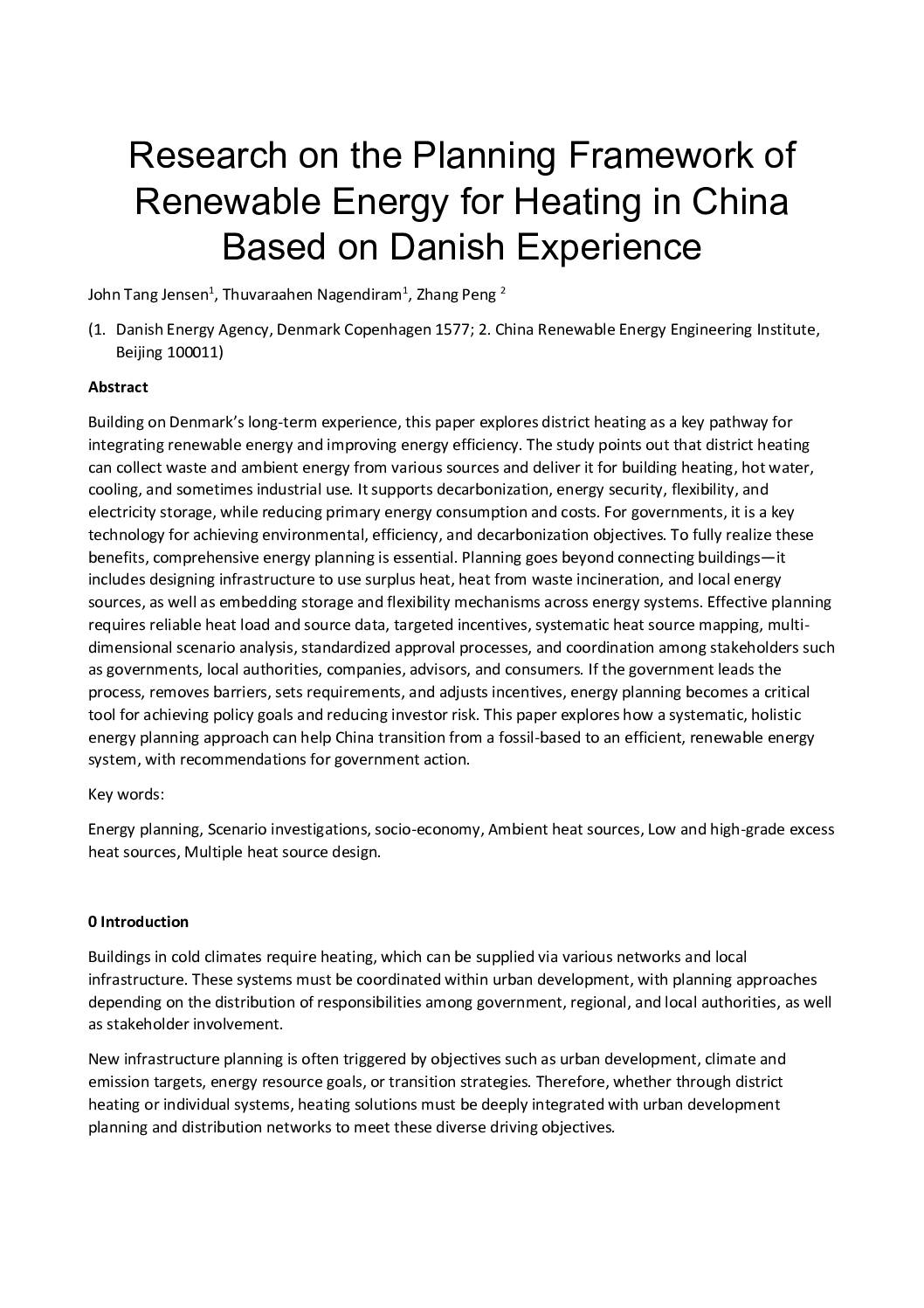
This paper focuses on the topic of heat planning. Building on Denmark’s practical experience in the green transition of the heating sector, the paper explores district heating as a key pathway for integrating renewable energy and improving energy efficiency. The study points out that district heating can utilize waste and ambient energy for building heating, hot water, cooling, and industrial use, supporting decarbonization, energy security, flexibility, and storage while reducing primary energy consumption and costs. For governments, it is a key technology for achieving environmental and climate goals. To realize these benefits, comprehensive energy planning is essential—going beyond connecting buildings to include surplus heat, local energy sources, storage, and flexibility. Effective planning requires reliable data, targeted incentives, heat source mapping, scenario analysis, standardized approvals, and stakeholder coordination. When governments lead the process, remove barriers, and align incentives, energy planning becomes a powerful tool for achieving policy goals and reducing investor risk.
In terms of structure and content, the paper first introduces the six key stages in the development of Denmark’s heat planning. Denmark’s heat planning evolved from an initial focus on energy conservation using CHP waste heat, to cost-efficiency with large-scale systems, and then to flexibility with heat storage and a ban on power-only plants. As renewables grew, electric boilers and heat pumps were added to absorb surplus electricity. After correcting a past mistake of installing individual gas boilers in areas suitable for district heating, modern planning now relies on fourth-generation networks to utilize low-grade renewable and waste heat. During the green transition of the heating sector, Denmark’s heat planning approach shifted from a response to the oil crisis into a strategic tool centered on flexibility—integrating the heating sector with a fluctuating renewable power grid, transforming district heating from isolated infrastructure into a core component of a low-carbon energy system.
The paper then presents the current challenges and future trends in China’s heating sector. It notes that for decades, China has utilized waste heat from CHP plants for district heating in cold urban areas, similar to Denmark, but this heat is wasted outside the 4–5 month heating season. While China shares Denmark’s climate goals (e.g., carbon neutrality) and low import dependency, its heating planning is project-based and linked to spatial planning, lacking explicit national directives. Current planning focuses on building networks where low-cost excess heat exists, but the fixed pricing system incentivizes expansion only to new, predictable buildings, not existing ones—a significant barrier. Although this system encourages some energy conservation, building temperature requirements (over 18°C) and a lack of accountability for building owners and consumer behavior hinder overall efficiency. As China increases its share of wind, solar, and hydropower, the role of CHP heat will decline, forcing a strategic shift. This puts China at a crossroads: pursue 100% electrification, adopt a flexible Danish-style integrated energy system, or develop a hybrid approach based on local conditions. Regardless of the choice, a clear roadmap with strategic planning and adjusted incentives is essential for a successful transition.
Finally, to address the challenges facing China’s heating development and planning, the paper draws on Danish experience and proposes a heat planning methodology tailored to China’s context. This methodology is structured around eight key components: 1) organizational setup, 2) kick-off event, 3)heat source mapping, 4) scenario analyses, 5) scenario selection, 6) action plan, 7) final heat plan and approval, and 8)approval process. The paper systematically demonstrates how a systematic, holistic energy planning approach can help China transition from a fossil-based to an efficient, renewable energy system, and offers recommendations for government action.
Note: The summary of this article is edited by Lipeng Zhang, Senior External Consultant of DEA.
Download sourceShare this
Sector: District energy
Country / Region: China, Denmark
Tags: district heating, local and regional energy planning, renewable energy, waste heatIn 1 user collection: Sino-Danish Clean and Renewable Heating Cooperation Centre – Library
Knowledge Object: User generated Initiative
Publishing year: 2026